Blog Preview
Let the Ships Sail in Peace
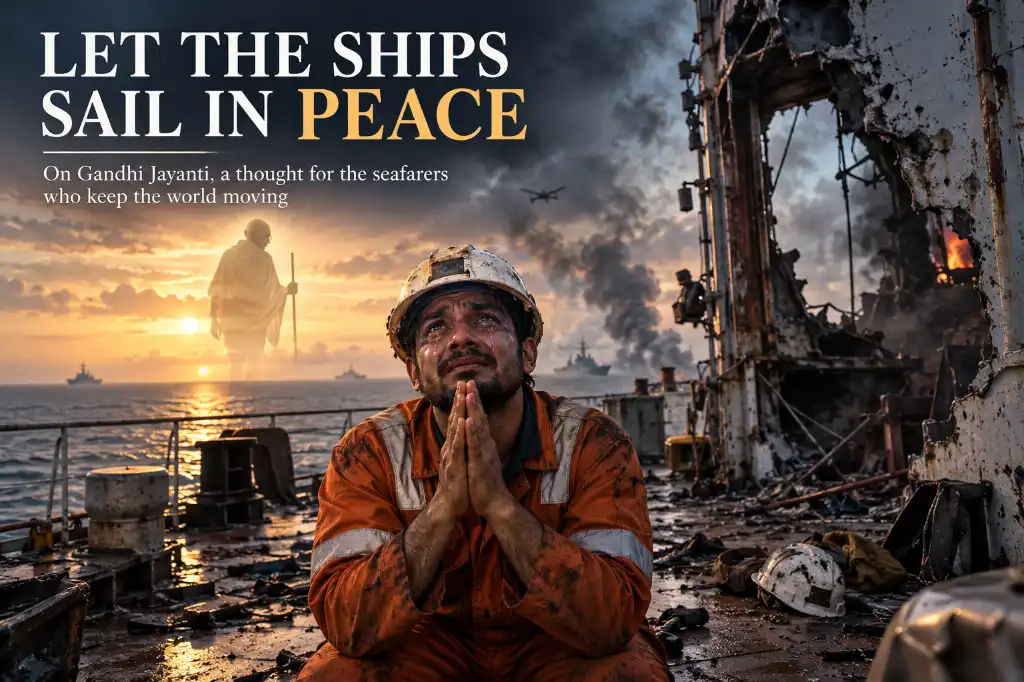
On Gandhi Jayanti, a thought for the seafarers who keep the world moving
Every seafarer who signs on for another contract hopes for much the same things: calm seas, a smooth operation, a timely sign-off and a safe trip home.
Life at sea rarely makes it that easy. There's rough weather, tight schedules, contract extensions, limited shore leave and relief that never seems to arrive on time. Now there's another worry: that the ship you're working on could be pulled into somebody else's war.
In 2026, merchant ships have come under attack in and around the Strait of Hormuz, the Red Sea, the Gulf of Aden, the Black Sea and the Sea of Azov. On 16 September, the International Maritime Organization (IMO) said it had verified 80 attacks on merchant vessels in and around the Strait of Hormuz since 28 February, with at least 22 seafarers killed and many more injured. By 24 September, its confirmed incident list had reached 85.
These aren't just shipping statistics. Behind every number is a seafarer, and behind every seafarer is a family waiting at home.
When war reaches a merchant ship
Seafarers understand risk. We train for fires, machinery failures, heavy weather, collisions and medical emergencies. War is different.
A seafarer doesn't decide when a conflict begins, which government imposes a blockade or which armed group attacks a vessel. A ship may fly one country's flag, belong to a company in another, carry cargo bound for a third and have a crew of several nationalities. The people on board may have nothing to do with the dispute, and they can still end up in its path.
The IMO's Secretary-General put it plainly in July: "Seafarers should never become casualties of conflicts to which they are not a party."
That should be more than a statement of principle. It should make us ask whether the international system really does enough to protect the people who work at sea.
A comparison with diplomats
International law gives diplomats a special status because the world recognized that diplomacy has to continue even when countries disagree or go to war. Under the 1961 Vienna Convention on Diplomatic Relations, diplomatic agents enjoy personal inviolability and protection from arrest or detention by the receiving state. Even in armed conflict, that state must help protected diplomatic personnel leave.
Diplomatic immunity isn't a blanket "untouchable" status, of course. It's a specific legal regime with defined rules. But the principle behind it matters: people performing an essential international function shouldn't become casualties of disputes between states.
Now think of the seafarer. A diplomat represents a government. A merchant seafarer represents neither side of a conflict and is simply doing a civilian job. Yet it's often the seafarer who is physically caught between the consequences of decisions made by governments and armed groups.
So the question isn't whether seafarers should get "diplomatic immunity." A better one is this: should the international community create a stronger, more clearly defined protected status for civilian seafarers caught in armed conflict?
The protections we already have
This wouldn't be starting from zero. The Second Geneva Convention of 1949 covers masters, pilots, apprentices and other merchant-marine crew when they are wounded, sick or shipwrecked at sea. International humanitarian law also protects civilian merchant vessels from attack unless they become military objectives under the applicable rules, and the crew's civilian status doesn't disappear just because the ship is in a conflict-affected area. The IMO's SUA Convention, strengthened by its 2005 Protocol, provides a framework for unlawful acts against ships, including seizure by force and violence against people on board.
So the problem isn't that international law has forgotten seafarers. It's whether these protections are strong, clear and practical enough for the kind of maritime conflicts we're seeing today.
When the ship becomes a trap
The Strait of Hormuz has exposed another side of the problem. In August, the IMO said that up to 400 ships carrying around 6,000 seafarers had been unable to leave the Persian Gulf safely since the conflict began. It later worked on an evacuation framework and reported that 136 vessels carrying about 2,900 seafarers were successfully evacuated, before the process was paused because safe passage could no longer be assured.
For thousands of people, their workplace became a place they couldn't safely leave. They weren't soldiers or diplomats, and they weren't negotiating anything. They were simply stuck on the ships where they worked.
This is where stronger protection is worth discussing. It wouldn't mean immunity from every rule, or a declaration that merchant ships can never be legitimate military objectives. It would mean a clear international commitment that civilian seafarers must not be deliberately targeted, used as bargaining tools, or left without practical means of evacuation when their workplace becomes unsafe. We need that answer before the next crisis, not after the next casualty.
Where Ahimsa fits in
Gandhi Jayanti is about more than remembering Gandhi. The United Nations observes 2 October as the International Day of Non-Violence, established by the General Assembly in 2007 to promote non-violence and a culture of peace, tolerance and understanding. This year's UN message again calls for dialogue, diplomacy, dignity and shared humanity.
For seafarers, Ahimsa can be understood in a very practical way: don't make ordinary people pay for conflicts they didn't create.
The IMO has repeatedly called for restraint, de-escalation and the protection of civilian shipping, and has warned that no commercial consideration should justify exposing seafarers to known and unmanageable danger. The next step is turning those principles into action, because a statement issued after an attack can't bring a seafarer back.
Let the ships sail in peace
A merchant ship may carry fuel, food, machinery or raw materials that millions of people depend on. But before it carries any cargo, it carries people. They spend months away from their families and work through storms, fatigue, inspections and port delays, and they ask for very little in return: a safe passage, a safe workplace and the chance to come home.
That's the conversation the maritime community should take to the wider world. It isn't about whether seafarers matter more than diplomats, or whether merchant ships deserve absolute immunity. It's about whether the people who keep global trade moving deserve clearer, stronger protection when wars reach the sea.
A diplomat needs protection because diplomacy must survive war. A seafarer needs protection because humanity must survive war.
So on Gandhi Jayanti, let diplomacy have space to work. Let international law protect civilians. Let merchant ships remain places of work, not battlefields. And let seafarers, whatever their nationality and whatever flag their ship flies, do their jobs without becoming the price of a war they never chose.
For the seafarers at sea.
For the families waiting ashore.
For a world where ships can sail in peace.
Fair winds, calm seas, and a safe passage home to every seafarer.
Want to learn and share your knowledge about the maritime world?
Explore the Blog app on Navvyx - Get maritime insights from across the world in one place.